IRIS Network awarded 14 small grants under CfP “Enhancing resilience of Civil Society Organizations (CSO)” in scope of the project „IRIS NETWORKing – CSOs for protection sensitive migration management“. IRIS network Project Evaluation Committee decided to support 14 out of 32 received applications in 5 project countries: Albania, Bosnia and Herzegovina, Montenegro, North Macedonia and Serbia.
Implementation of all supported projects starts on 5th March 2021 with a duration of two months. The grants aim to support IRIS members in capacity-building actions for the purpose of enhancing the organization’s abilities to develop adequate services, capabilities, and skills as a response to the pandemic crisis.
As IRIS Network members are facing unprecedented challenges from COVID-19 and the strain on the services and resources they provide is tremendous, this Grant Scheme is taking proactive steps to protect the Network members, support their ongoing activities and assist them to cope with current hardships as much as possible. Project proposals shall aim to produce an added value to the “IRIS Networking” project’s efforts in this domain.
Iris network would like to congratulate all of its member organizations who received grants, but also to thank all applicants who sent us their proposals. The final list of all organizations that received grants can be found in the following table.
https://iris-see.eu/wp-content/uploads/2021/03/Iris-sajt-prateca-05.03.2021..jpg788940Stefhttp://iris-see.eu/wp-content/uploads/2015/01/logo.pngStef2021-03-05 11:35:192021-03-05 12:01:39Enhancing resilience for 14 local service providers in SEE
https://iris-see.eu/wp-content/uploads/2021/01/Iris-grant-scheme-2020..jpg640504Stefhttp://iris-see.eu/wp-content/uploads/2015/01/logo.pngStef2021-01-15 08:27:332021-01-26 08:30:36Iris Network Grant Scheme results for 2020
It
has been two weeks since the IRIS Network Social Academy was conducted. What
have we learned? Has agile already become a part of our business or at least
our mindset?
Participants
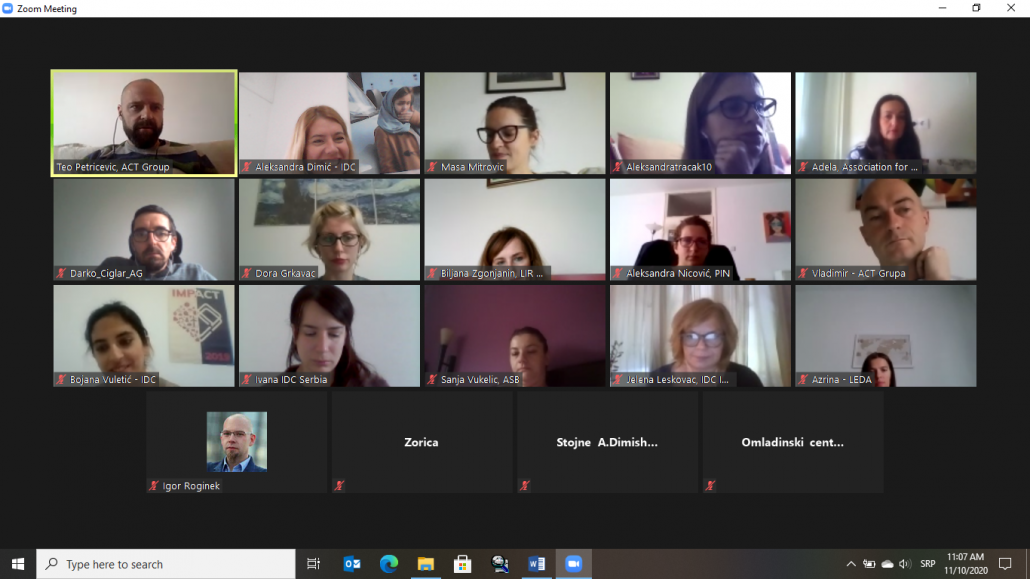
and trainers gathered once again to reflect on lessons learned and exchange feedback.
Teo Petricevic, Director of the ACT Group, highlighted that in agile management, one should lead by example. He emphasized that the transition process from traditional to agile takes time and patience. Teo and the entire team of trainers are satisfied with the performance and exchange of knowledge and experiences.
Nearly all participants expressed the willingness and readiness to incorporate agile management tools and methodologies into their everyday operations and organizations.
Some IRIS Network members shared that after the Academy they have recognized aspects of agile within their business culture and organizations.
The majority of participants are ready to embrace the changes and challenges that come with agile management
https://iris-see.eu/wp-content/uploads/2020/11/FOLLOW-UP.jpg788940Stefhttp://iris-see.eu/wp-content/uploads/2015/01/logo.pngStef2020-11-10 12:51:592020-11-10 13:20:48Third Iris Network Regional Social Academy follow up
Third Iris
Network Regional Social Academy is finished!
The Third Iris Network Regional Social Academy successfully completed – three days, 36 participants, exchange of experiences, and shared know-how for the benefit of all participants and their organizations.
We talked about the application of agile methods in management, as well as the structural changes that this way of management brings.
Trainers from the Third Iris Network Academy guided the participants through the sessions:
Impact Focused Strategy
Agile Project Management; Agile Methodologies
Combining traditional top-down and agile bottom-up approach
Planning, Tracking, and Monitoring
Ensuring Delivery of Value and Quality in Agile Projects; Risk Management
Budgeting agile projects and budget management
Leading an Agile Team
Managing Stakeholder Engagement
Agile Project Management Tools and Technologies
Leading the Agile Organisation
Measuring & Managing Impact
Communicating Impact Effectively
Representatives of organizations from five countries – members of the Iris Network had the opportunity to discuss the transition from traditional project management to agile methodology, hear the experiences of others, and increase their knowledge on the issue.
Academy aroused
many discussions with several messages for the future:
We are not here just to deliver service, but to produce systematic change by maximizing our impact
Stakeholders have rights, but also responsibilities in an agile environment. We have to work to involve them much stronger in the process
We are organizations that have a say in designing financial instruments to achieve the change we want to see.
We are practicing openness to learn and adjust, mastering the art of letting go of old
Celebrate your many successes to become more motivated, it empowers your organization. Simplicity is an important part of the agile approach, do not be afraid to fail, embrace failures
In the coming period, the Iris
Network will strive to apply the transferred knowledge and thus improve the
functioning of the only regional network in the Western Balkans of CSOs
providers of social services.
Under the framework of IRIS Networking CSOs for protection sensitive migration management, the project is funded by European Commission and implemented through joined forces of 6 NGOs from 5WB countries: IDC Serbia, ASB South East Europe, SOS Podgorica, LIR Civil Society from B&H, ARSIS Albania and La Strada North Macedonia.
https://iris-see.eu/wp-content/uploads/2020/10/Iris-akademija-u-toku.jpg788940Stefhttp://iris-see.eu/wp-content/uploads/2015/01/logo.pngStef2020-10-29 12:39:092020-10-29 12:41:13Third Iris Network Regional Social Academy is finished!
Call for Application – Regional Social Academy “Agile Organisational and
Project Management”
After two successful Regional Social Academy of IRIS Network, held in Belgrade and Tirana weare announcing the Call for participants of the Regional Social Academy, which will be held online from 26th to 28th October 2020.
The Academy offers participants further support in organizational development – changing the paradigm: moving from a traditional organization working as a “machine” to the new organisation working as “organism”. This year Academy will focus on new knowledge and skills of CSOs management and senior staff in agile organizational and project management – impact strategy design and management, agile project management, budgeting, agile leadership, and team management, leading the agile organisation, impact measurement, and management methodologies and practices.
Participants will attend 3-day tailor-made training consisted of online lectures and workshops. The Academy program will enable further improvements and optimization to the needs, interests, and constraints of the target groups and their institutional and organizational environments.
All information and application procedure you can findhere.
The deadline for the application is 14th October 2020 at 17 p.m.
The final participant list will be announced on the IRIS Network website (www.iris-see.eu) no later than on 16th October.
Successful participants will obtain certificates, and enter Academy Alumni. Upon the training, each of the participants will have the opportunity to participate in a Follow-up check-point session which will be held on the 9th of November 2020, online.
Regional Social Academy is part of the regular IRIS program activities, organized annually.
Photos and impressions from First Regional Social Academy you can see here.
Photos and impressions from Second Regional Social Academy you can see here.
https://iris-see.eu/wp-content/uploads/2020/10/prateca-final.png653779Stefhttp://iris-see.eu/wp-content/uploads/2015/01/logo.pngStef2020-10-06 11:38:102020-10-06 15:43:30Call for Application – Regional Social Academy “Agile Organisational and Project Management”
IRIS NETWORK NEWSLETTER –JANUARY – JUNE 2020 COVID REACTION STORIES
In spite of the global scale, severity, and
widespread uncertainty of the coronavirus outbreak, which hindered the efforts
of the Iris Network and its members, the Network has been regularly following the
activities of its members, especially their responses throughout the ongoing COVID-19 pandemic.
One of the lessons learned in the face of the
pandemic was that the ability to react promptly and tackle the new challenges in
an innovative way have been pivotal in surpassing the crisis. For that reason, the January –June
Edition of the Newsletter features the stories of the Network members,
in which they shared how they managed to adapt their activities to the new
reality.
Along the same lines, the Iris Network conducted
a survey among its members and based on the thorough analysis of their responses
complied a Report
on Social Services
during Coronavirus Pandemic
in Western Balkan
Countries (link).
Members of the Network reported that they have not been included by local governments to participate, discuss and create adequate responses and policies pertaining to the protection of rights of vulnerable categories during COVID-19. Likewise, IRIS Network members indicated that only a few local authorities have implemented measures in order to maintain current social services, support them and mitigate the critical situation. More so, sources of funding constitute by far the greatest challenge in the current situation, while majority of the survey participants expressed their concern regarding future sources of funding and declared that their expectations lay within the pool of international donors.
Women’s Association “Nature”, Bratunac immediately after declaring the Corana virus emergency made all its available resources available to the Bratunac Red Cross Municipal Organization and the Center for Social Work. The staff and volunteers of Nature have become volunteers of the Red Cross, and the Chancellery of Nature and the technical resources at our disposal serve the needs of this situation. Volunteers distribute masks (which some of our members and sew) on a daily basis, on calls coming to the Red Cross info center deliver food to elderly people who cannot move, deliver medicines according to prescriptions delivered from the health center, pack and distribute food and hygiene packages to vulnerable populations. “Nature” pay particular attention to vulnerable categories, which are their beneficiaries, such as women victims of war, women from large family, single mothers, women at risk of domestic violence or women victims of domestic violence. Women’s Association “Nature” currently considering setting up a SOS line for psychological support for this vulnerable category.
IRIS Network considers important to assess the situation, challenges and difficulties its members as well as others CSO’s that are facing in the provision of social services and their everyday work as a result of the current COVID 19 pandemic.
We have responsibility towards its members as well as to other parties to have a detailed overview of their current situation and to provide this information to the EC, as the donor. This will be conducted through a questionnaire CSO’s can fill in on link below.
Therefore, the objective of the questionnaire is to assess the current situation and consequences caused by COVID 19 pandemic on the provision of social services to beneficiaries provided by IRIS Network members in their local communities. The results of the questionnaire will be used for developing a Report on Social Services in South East Europe under the COVID 19 pandemic and will include the following countries: Albania, Bosnia and Herzegovina, Montenegro, Serbia and North Macedonia. The Report will be used to assess the actual challenges that civil society organizations providers of social services face in working with beneficiaries and to map the assistance models.
The Report will also be used as an instrument in advocating for policies and measures of national/regional/ EU Institutions which focus on service providers during and after the crises.
Please provide detailed information in the questionnaire and include all information you consider relevant. Also, please include your projections and the assessment of the consequence caused by the crises that will affect your services and the whole social protection system.
For all interested CSO’s providing social services – you can fill in the questioner on the link below .
Representatives of the IRIS network attended the UNHCR Serbia refugee protection group. The graphic shows key conclusions.
https://iris-see.eu/wp-content/uploads/2020/04/iris-grafika.png960384Stefhttp://iris-see.eu/wp-content/uploads/2015/01/logo.pngStef2020-02-24 09:43:152020-04-02 09:50:07UNHCR Serbia refugee protection group short report
After 6 days of visiting refugee camps along migrants route in Macedonia, Serbia and BIH, we concluded the Balkan Media Caravan, an initiative of IRIS network which was held from 3rd – 8th of November. The event was organized by IDC Serbia and ASB South East Europe, with support of national partners.
The aim of the caravan was to enhance human, sensitive and
objective reporting on migrations in the region by increasing the level of
knowledge and information among journalists.
The caravan gathered 20 young journalists of reputable national and local radio stations, television, newspapers and digital media on the 6-day training aimed at sensitization of reporting about migrants and refugees while tackling the topics of integration of migrants and reintegration of returnees into the society.
The Media Caravan included trainings, workshops, lectures from human rights defenders and journalists from the region and field visits to refugee camps in North Macedonia, Serbia and Bosnia and Herzegovina, with the possibility to conduct interviews with migrants in these countries.
Participants were journalists from media outlets in Albania, Montenegro, North Macedonia, Serbia and BIH.
During the Caravan, the journalists had a task to produce,
as an output of the Media Caravan, up to 15 reports in their media outlets,
which have been prepared under the guidance of experienced trainers-journalists
and which have been published and broadcasted by journalists in their media
outlets.
Besides training and field visits to migrant reception and
transit camps in 3 countries the journalists had an opportunity to meet local
CSOs providers of social services to migrants/refugees/returnees and the
representatives from local health institutions.
The Balkan Media Caravan had high coverage during the trip and afterwards.
Participants were from different national and regional media outlets, covering all together more than 10 million people in Western Balkans countries:
Up till now, 23 reports were produced and broadcasted
regarding Caravan and migrants crisis on Balkan route: 10 TV, 8 printed, 1
radio, 3 agency and 1 web reports.
Additional to this, reach was increased by posting all
reports that were produced in traditional media on their web sites, Facebook
and Twitter pages, increasing also the frequency of the event and closely
influencing on the our target group.
Over 7million people were potentially reached through broadcasting TV reports, with additional reach of almost 500,000 people trough newspapers, web and radio publications. Campaign on Facebook, Twitter, YouTube and Instagram brought us reach over 200,000, so we can easily say that IRIS Media Caravan media outputs potentially reached over 7,5 million people across the Western Balkan countries.
***
20 journalists from 5 countries spent 6 days on the caravan visiting 3 countries, 7 migrant camps and 10 CSOs providers of social services for migrants along the route
Balkan media caravan is organized in the framework of the project ” IRIS networking CSOs for protection sensitive migration management”, implemented by IDC Serbia in cooperation with partners ASB South East Europe, LIR CD, SOS Podgorica, Отворена Порта – Open Gate: La Strada, North Macedonia, and Nisma për Ndryshim Shoqëror, ARSIS Albania
Project is funded by the European Commission.
https://iris-see.eu/wp-content/uploads/2019/12/2019-11-06_15-32-42DSC_0709.jpg16632500Stefhttp://iris-see.eu/wp-content/uploads/2015/01/logo.pngStef2019-12-20 13:13:222019-12-20 14:13:06IRIS Balkan Media Caravan on the way through the migrants route